

Angwin: Machine Bias, Singer: Amazon’s Facial Recognition

The New York Times article covered the flawed facial recognition technology created by Amazon. With a database of 25,00 publicly available mugshots, the “technology incorrectly matched lawmakers with people who had been charged with a crime.” Although the software initially served to prevent human trafficking, facial recognition is fast becoming a top target for civil liberties groups and privacy experts. This way, civil liberties groups view it as a surveillance system to lower political protests by eliminating anonymity. In the wrong hands, facial recognition can be inseparable from a tool of social control.

Northpointe’s algorithm has been shown to turn up flawed results. Broward County, Florida uses the score in pretrial hearings, and ProPublica’s research proved it remarkably unreliable. Only 20 percent of those predicted to commit violent crimes did so, and when looking at all crimes it was only slightly more reliable “than a coin flip.” Moreover, it turned up black defendants as more likely to be future criminals two times as much as whites, and also incorrectly labeled whites as low risk more frequently.

Regarding ethics, we determined multiple options for possible outcomes. One extreme would be for technologies such as the risk assessment algorithm and Amazon’s facial recognition to continue to be used in their current capacities. This would mean bias being perpetuated in yet another mode. The opposing option for the former would be for these technologies to be banned entirely. While this would prevent the fundamental flaws currently happening with both the algorithm and facial recognition, there are also benefits that can be had from using this technology, were bias, specifically against people of color, to be removed. As we spoke about in class, just because a product has a high success rate, that does not mean that the success rate of predicting is equal among everybody. Thus, while an average looks successful, the accuracy can be completely skewed. Therefore, the third alternative, which is the alternative our group said we could live with, is to ban products like these until they can be re-thought and created to display no bias.
Fake News and Lethal Robots

In the article, “Fake News and Partisan Epistemology”, Regina Rini expresses concerns about the epidemic of fake news being spread so widely and rapidly on social media platforms today. Fake news is deliberately deceptive, it is meant to catch the eye and catch clicks for the purpose of generating revenue for someone’s website. A variety of epistemic virtues are strangely abandoned on the platform of social media. The article investigates what features of social media make it so easy for people to abandon epistemic virtue. Rini points out that partisanship is the reason that people are more likely to surrender epistemic virtue and readily jump upon wild and outrageous conspiracy theories which to anyone with a critical eye would warrant some skepticism. The way partisanship manifests itself as an opponent to truth is when people share particular political affiliations with others. Those people are seen as closer to themselves and are seen as right simply because the receiver of the fake news assumes that anyone who shares their political opinions must be feeding them proper information. This mainly has to do as well with our willingness to believe testimony outright rather than cross checking every bit of information that is fed to us. Believing testimony is individually reasonable and Rini argues that the mechanism of social media takes advantage of this individually reasonable behavior and co-opts the space of testimony in order to spread misinformation. Rini believes a possible solution to this phenomenon is for social media platforms to flag individual accounts which regularly spread misinformation and to create a sort of score which measures credibility thereby making people take more responsibility for the things they post.

This article begins to consider the implications of machines used as military weaponry. Specifically, should machines be able to kill people in combat? It’s clear that even things that are not designed as weapons have the power and potential to be used as weapons..even a toaster. While robots themselves were never intended to replace humans in war they serve as a way to potentially decrease casualties while also being able to make the choice to kill another person at will. The article explains that this is exactly the issue in that robots have no “will” or morality and than even while war literally means death the only people who can be the perpetrators of death must also be willing to be the recipient of it themselves.
After detailing the various background information regarding the types of weapons and the laws of war, the authors proceed to address the major question of their essay: “should we relinquish the decision to kill a human to a non-human machine?” (134). In order to treat this profound question, the authors expound on the philosophical definition of a human being, a being with intrinsic dignity and rights according to Immanuel Kant. Using a robot to kill a human treats a human being as a mere object, and therefore denies human dignity. Furthermore, the authors discuss morality as an essentially human characteristic, and maintain that a robot could only imitate moral actions, without being in itself moral. They also discuss LAWS as being potentially dishonorable, in that they negate the risk of immediate sacrifice inherent in war. Without the potential for sacrifice, the use of robots becomes cowardly, and thus contrary to what is considered honorable military conduct. The authors conclude by postulating a complete ban on autonomous weapons systems, much like the current status of chemical and gas weapons, considered too heinous to be tolerated.

Luerweg: The Internet knows You Better Than Your Spouse Does

“The Internet knows You Better Than Your Spouse Does,” by Frank Luerweg describes how internet algorithms use psychology to identify personality traits of users. One algorithm used a small number of Facebook likes to pinpoint the “Big Five dimensions of personality.” With only ten likes, it could describe someone as accurately as a co-worker of theirs. This type of technology extends beyond internet algorithms. Studies observing participants’ eye movements were able to accurately describe their personalities based on where they look when walking around a college campus and shopping. Cameras on our computers and smartphones have the potential to read our emotions.

Even though the algorithms are based on personal information, facial expressions and psychological traces are maliciously and commercially used, there are some cases for which algorithms were used to better diagnose and treat psychological disorders and prevent suicide. In some research, the language that people typed and spoke on the phone were gathered and analyzed through the algorithm and it could determine the precursors of suicide and severe depression quite accurately. Moreover, a research team gathered every data from a tester from GPS data to phone calls and what he read on the phone. The team precisely analyzed and could better treat the patient with the result in which level the patient is suffering with a bipolar disorder.

In spite of potential positive effects from such advancements in technology, there are still potentially great drawbacks towards the Internet’s ability to recognize a user. While recognizing a user is mostly used towards commercial matters such as advertisements to suit the user’s preference, such information can result in modern day machine’s being able to use the algorithm in order to correlate further into a person. Such can include personal information such as using photos as facial recognition, with common photo algorithms pointing towards people in manners such as personal information like their orientation, or in certain cases, to recognize if a person has potential criminal tendencies. All this however, comes down to correlating through the given information, but as technology advances, they can lead towards further accuracy, and can reveal more of a person than what was intended by that user. In the end, even the slightest comment or photo on the Internet could open a book into a person’s world.

Paragraphs, in oder, by Georgia, Sean L., and Gabriel. Compiled by Georgia.

Complexity and Quantum Computing (Blog)

In class, we discussed the Computability capabilities of modern computers. Although they are exponentially more efficient than their 40-year old counterparts, computers still struggle what can be computable. One way to approach this issue is to improve the amount of steps that an algorithm takes to sort or search through a list. For example, a linear search requires an n amount of steps to achieve while a binary search requires a log2n steps. With lists containing thousands of elements, binary search makes the difference between ten steps to thousands of steps for linear search. Apart from the efficiency of an algorithm, there is also another component that saves time and money: circuits. Seven decades ago, computers consisted of moving parts, such as vacuum tubes, to calculate mathematical functions. It all changed once transistors were used to compute. Unlike physical components that turn on and off, transistors are small, efficient, and do not generate as much heat. Compared to the 1980’s, a problem that required months to solve is now solvable in minutes. This revolutionary discovery sparked the birth of the Digital Age. This is an improvement, but is there an even faster method of computing? With  the help of physicist and their knowledge of Quantum Mechanics, computers can work at unbelievable speeds using Quantum Computing.

In Quantum Computing (closely linked to quantum mechanics), quantum bits (or ‘qubits’) can simultaneously hold values of 1, 0, or both, rather than being set to 1 or 0 as traditional electronic bits are. This way, one qubits can hold the same information as 3 bits. As good as it sounds, quantum computing is still in its infancy since Quantum Computers are large machines that are somewhat unreliable and not yet very powerful. Regardless of the current struggles for these computers, large technology companies, such as Google and Nasa, are experimenting and building the first quantum computers. For example, Google strives for the future of computing and proclaims that their “D-Wave 2X quantum computing machine has been figuring out algorithms at 100,000,000 times the speed that a traditional computer chip can”. Although the product is not available to the public, such efforts are a great step forward for the future of computing.

So, if Quantum Computers are still in their infancy, then why should we care so much about them? In the best scenario, they have the potential to blow right through obstacles that limit the power of classical computers, solving problems in seconds that would take a classical computer the entire life of the Universe just to attempt to solve, like encryption, optimization, and other similar tasks. They are powerful, but things can go wrong if they are used for unethical reason such as online theft and security breaching. In the Digital Age, it is crucial to promote the application of Quantum Computers along with their ethical implications. Without the proper education, Quantum Computing can be a step forward for scientific research or a step backwards for the world economy.

Privacy and Data Sovereignty

Talking about the ethics of social media companies controlling our data made me think of an episode of Hasan Minhaj’s “Patriot Act” on Netflix. Minhaj discussed these same topics that were brought up in discussion on Monday, including the seeming cluelessness of lawmakers as to the basics of technology, as well the rich collection of data companies have built up. His main conclusion of the episode is that regulations of these companies need to change to protect our data and treat these companies as what they really are: glorified ad agencies.

The discussion also made me reflect on the difficulties or protecting our information absent necessary legislation. Because so much of the modern life relies on the internet, it is almost impossible to go completely off the grid unless you have already lived as a hermit, or you are Ron Swanson from “Parks and Recreation.” I am extremely troubled by this. Technology is a basic fact of life at this point; it is unsettling that companies are able to have an extremely detailed record of our locations, store every single one of our internet searches, and keep track of what we interact with on social media, all in the service of creating a detailed profile to sell us more. This is made worse by the potentiality that law enforcement could possibly gain access to all of this data in the future in a potentially incriminating way.

As Minhaj suggested in his show, the best possible method forward is changing the way companies interact with our data, and, as mentioned at the end of class, convincing legislators requires organization. I do not have the technical knowledge to propose nuanced solutions to these problems, but in the meantime, I will try to remain extremely conscious of the way I use my devices and these platforms.


Overlooked weaknesses of the Internet and SNS

Social network services (SNS) such as Facebook and Twitter have a huge impact on society. SNS influenced politics, economics and our daily lives in every world. There are some countries in Europe that succeeded democratizing and SNS helped the processes. In Moldova, it cannot be denied that SNS helped to gather the crowd and fueled the flames of protests. More than 900,000 people gathered through a Twitter hashtag, but as soon as the government blocked the internet, they lost what to do and the will to fight. Two issues arose in my after reading the article.

First, should the government censure any stuff in SNS? I think there need to be some regulations to prevent sexual abuse, violence and any inhumane discriminations. However, the problem is that once the public gives the government a power to control the internet and SNS, they can do something other than what they were supposed to do in specific occasions like political protests.

Secondly, I realized that people have been overlooked the blind spot of the internet and SNS. What happens if we don’t have access to them and if this is intentional by some parties? This sounds unlikely, but it is a point to think about. People hugely rely on computers, internets and SNS, and they are definitely helpful. But at the same time, we need to know that they also have some limits. They are not something operated automatically, but instead, they are controlled and managed by someone with intentions. In the article we read, Moldovans did not know how to keep protests when the internet was blocked.

Merge vs. Quicksort (Blog)

In class today, we covered the current Complexity and Computability for Computers.These concepts are essential to Computer Science because the process of writing algorithms is not limited to writing correct syntax. In fact, that is the first step for programmers. Once the programmer understands the syntax for a language, he or she must then research how much money and time an algorithm requires because every additional bit costs a lot for storage. These questions are not covered in introductory programming, but they make the difference between writing a program to count apples to finding the fastest route between points. Although Graph Theory solves this problem, there is plenty of real life applications, from walking between classes in college to how Google Maps gives you the fastest route to your destination. So, how is one algorithm better than the other? Well, one algorithm is considered better if it takes less steps to complete.

In the context of our class, we covered two sorting algorithms: Insertion and Merge. Insertion takes n^2 number of steps to complete while Merge takes n*log2n steps to complete, n being the size of the list. Through these examples, it is clear that Merge sorting is better than Insertion. However, is it the best? Well, not really. At the end of the day though, whatever the best sorting algorithm really is depends on the input (and who you ask). There is an algorithm known as Quicksort which can take less steps than Merge steps. The time complexity of Quicksort is O(n log n) in the best case, O(n log n) in the average case, and O(n^2) in the worst case. Let’s discover how they compare:

Like Merge sort, quick sort works like a recursive procedure (a function that calls itself). The key to understanding this algorithm is to think of it as a pivot. Without going into too much detail, this is how it works: the goal is to rearrange the array such that all all elements less than the pivot are to its left, and all elements greater than the pivot are to its right. Sounds simple, but how to do it will take me pages. Regardless, the important distinction is storage. Why quicksort is better than mergesort ? Quick sort is an in-place sorting algorithm. In-place sorting means no additional storage space is needed to perform sorting. Merge sort requires a temporary array to merge the sorted arrays and hence it is not in-place giving Quick sort the advantage of space. Like I mentioned before, more storage equals more money. So, in terms of price and speed, Quicksort outperforms Merge Sort.

That was a lot of information, so what’s the importance? Well, the problem lies when programmers that are only taught syntax never consider storage cost and processing power. Unless we do something about it, potentially billions of dollars are at stake for storing the large quantities of information from the Digital Age. To further the conservation, here are some additional questions to build upon: can we build faster and cheaper sorting algorithms? If so, how? Is there ethical implications of storing and sorting so much information at a faster rate? How can we assure that all programmers understand the implications of writing code?

Mondays discussion

Monday’s discussion dealt primarily with ethical situations we had not begun to discuss much in class like the implications of privacy and large tech corporations selling our information. I think I want to take this time to say more about how these problems are also connected to the disparities of women and others not male in the technology sector. The industry is also preying on these groups of people significantly more for location data, buying trends and personal information. I feel like this often never gets enough attention because its happening to those most closely centered on the “margin” of who we consider important or worth saving.

I might also add that the preying on these groups also repudiates many harmful cycles of fake news, propaganda and false reporting that leads to many consequences. The need for these groups to really take over the technology sector is immediate and the digital privacy disaster we are in right now can only be minimized if we bestow agency back to these groups in a commitment that is long overdue.

Reflecting on Monday’s discussion

What  struck me most from the discussion on Monday would be just how widespread and trenchant access large companies, like Facebook and Google, have to our ‘personal’ data. This trend worries me considerably. I feel like privacy rights are almost obsolete in an age where so much information is readily available digitally, often without the user’s knowledge. Luis’ requesting his data from Google really substantiates this point. There really is an exhaustive record of everything we do on the internet.

Now of course, we all see this as troubling and we all don’t desire our personal information to be collected in such a manner. However, we all continue to use Facebook, etc. for a variety of reasons. Whether it be convenience, comfort or habit, we continue to be involved in social media and other digital enterprises that result in data collection. To be truly removed would be living off the grid, something few people are willing to do. This fact led me to the unhappy conclusion that this type of infringement on privacy is an axiomatic result of living in the digital age. I hope this is not the case, but unless people really make a concerted effort to address this issue, I’m doubtful of anything changing soon. That being said, I do believe many people are concerned about this and are actively trying to change things for the better.

Project idea brainstorm

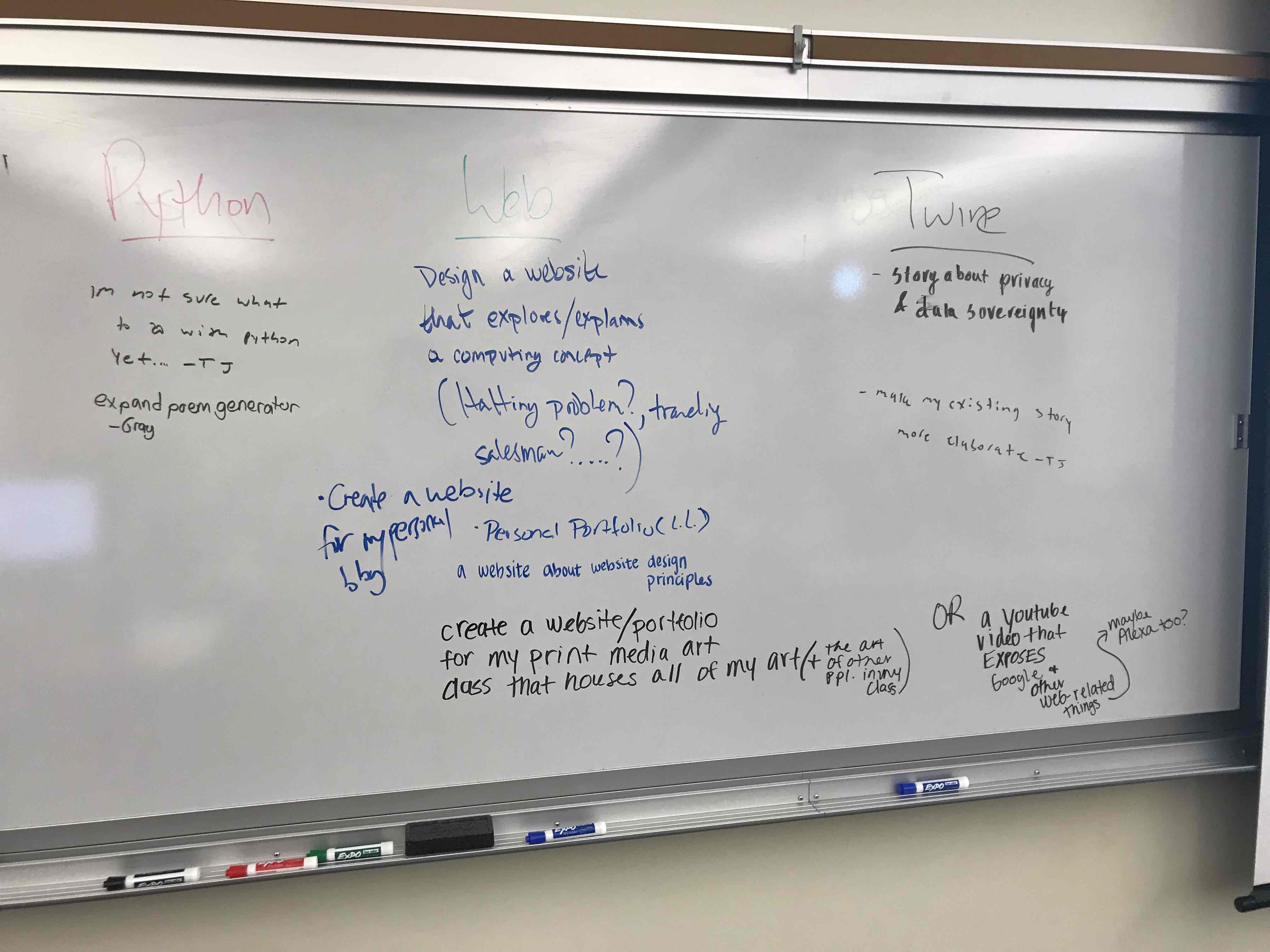
What the board said:

White board with project ideas


My best attempt to transcribe:

Python

  • TJ: Not sure what to do yet
  • Gray: Expand poem generator

Web (mostly without names)

  • Design a website that explores a computing concept (halting problem? traveling salesman?)
  • Create a website for my personal <something>
  • Luis: Personal portfolio
  • Georgia (I think?): A website about website design principles
  • Kate (I think?)Create a website/portfolio for my print media art class that houses all of my art (& the art of other people in the class) OR a youtube video that EXPOSES Google & other web-related things (maybe Alexa too?)?

Twine

  • Story about privacy & data sovereignty
  • TJ: Make my existing story more elaborate