A video co-produced by the Australian Academy of Science that actually builds quite nicely from the concepts we have discussed in class: Quantum Computers Explained.
Quantum computing
Leave a reply

A video co-produced by the Australian Academy of Science that actually builds quite nicely from the concepts we have discussed in class: Quantum Computers Explained.
The Nakamura article told a story that complicates the narrative of Silicon Valley being the epicenter of the technological revolution. Rather than simply retelling the already household histories of tech giants like Steve Jobs and Bill Gates Nakamura focuses on the contribution of Navajo women who worked at the Fairfield plant in New Mexico producing computer chips. Because the Navajo women were willing to work for a low wage and because Fairfield could avoid paying taxes by building on reservations, costs remained low.
Fairfield publicized that these women were particularly well suited for the job due to their transferable skill from their practice of weaving, an algorithmic art that was often overlooked due to its association with the domestic sphere. Because of the meticulous attention to detail necessary to weave rugs, Navajo women were seen as perfect for producing chips accurately, quickly, and painlessly. These women were also hailed as the ideal workforce because they were mobile, cheap, and above all, flexible; they could be laid off at any time. As a result, their previous experiences allowed for these digital circuits to be manufactured in such a large scale.
However, although this decision to insource work was advertised as of dual benefit to both Fairfield and Navajo women from both sides, the project did not result in a great economic payoff to the women themselves. Furthermore, the manufacture itself was made to seem like it was “preserving” Navajo culture. Nakamura describes a Fairchild brochure from 1969 in which the transition from weaving to circuit making is made to seem an “extension of Navajo culture. Through the reading we come to understand that it is not due to these traits that Navajo women were hired, but rather, as Nakamura eloquently explains, “these traits were identified after the company learned about the tax incentives available to subsidize the project, the lack of unions and other employment options in the area…” (Nakamura, 935). Thus, while on the base surface the whole project was seen in one light, Nakamura urges us to realize and understand the “cultural” rhetoric adopted for the exploitation of the fact that there was a lack of jobs for Navajo women.
This article comes from the tradition of critical theory, calling for us to look beyond the commonalities of the digital field and see this labor for what it is, digital manufacture, not an innate part of the “Indian psyche.”
Transistors were the successors to the vacuum tube technology which dominated the electronics industry through the mid-1950s. Following the invention of transistors, engineers began to design more complex electronic circuits with a variety of components. In order to improve the performance of the electronics, more components were necessary. At the time, this meant that thousands components had to be connected by hand soldering a bunch of wire. This was expensive, time-consuming, and faulty.
Jack Kilby realized that the resistors and capacitors used to make electronic circuits could be made from the same material and interconnected in a single circuit and thus, he built the first successful integrated circuit made of germanium in 1958 at Texas Instruments. Robert Noyce of Fairchild Semiconductors built an integrated circuit on silicon in 1960 and along with Kilby is considered a co-inventor of the integrated circuit. Silicon is the most popular material for semiconductors today and Noyce’s design was overall more suited to mass production. Noyce was also one of the co-founders of Intel, one of the largest manufacturers of integrated circuits in the world.
In the late 1950s, Gordon Moore noticed that transistor density (as in the number of transistors) on integrated circuits was doubling each year. Moore eventually condensed these observations into Moore’s Law, which charts a progression of growth in transistor density eventually leading to exponential increase and thus an exponential increase in processor speed. So far, Moore’s Law has proven to be accurate.
The first uses of the newly invented integrated circuit were fairly select. Texas Instruments, the company where Jack Kilby worked, developed a handheld calculator using the technology. The military and space exploration agencies also made use of the integrated circuit.
Silicon Valley arises out the silicon chip manufacturers within the area because most semiconductors are made from silicon. The 1980s brought widespread use of the term Silicon Valley because of the IBM personal computer that used the chip as well as many semiconductor companies in the surrounding area. Silicon Valley is now the home of many technology giants as well as thousands of small start ups aiming to make a considerable impact.
Division of labor: Each group member summarized about two pages of the text.
Today, computers have their basis on electronic circuits. However, far before computers and electronic circuits were invented, vacuum tubes were used as basics for electronics. People were able to use vacuum tubes in more advanced machines like computer, but constraints of vacuum tubes limited their further usage. Therefore, miniaturization of the electronics system, as an alternative of vacuum tubes, was led by military and space agencies.
The concept of a monolithic piece contributed to how the circuit was developed. Jack Kilby (whose Nobel Lecture was the reading this post is based on) saw that semiconductor materials could be used to make transistors and diodes, ultimately leading to a circuit built from a single material. He used germanium (and later silicon) to build first a chip out of discrete components, then one that was completely one piece.
The integrated circuit was far from an instant success. Many in the computing community expressed concerns and critiques. Some believed no single material would effectively support the integrated circuit. Others thought it would simply never be profitable. Aside from these practical concerns, there were concerns about the human implications, a reminder that computers are fundamentally a human output. The integrated circuit could put circuit developers out of work. As the technology developed, however, it became apparent that it created more, if different, employment for such workers.
Despite early doubts about the practicality and use of the integrated circuit, endorsements by the military for the Apollo moon missions and Minutemen missile program proved a huge push. Soon, the technology made its way into civilian goods, with Texas Instruments producing the first handheld mechanical calculator. Today, the production of and the actual performance of integrated circuits improves drastically with each year. With this, the technology may soon be reaching its natural limit, in which case new innovation might be necessary.
Each paragraph was written by (in order) Sean, Gabriel, Georgia, and Charles. Compiled and edited by Georgia.
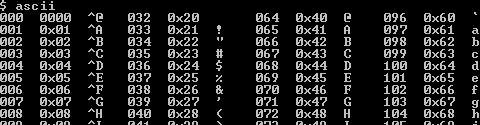
Following up on the Python demo we did during the character representation lecture: when we finally got to the correct encoding scheme for the characters to make sense, why did our three characters turn into two characters?
For starters, this demo was drawn from Sebastian Mathot’s blog post, “A simple explanation of character encoding in Python.”
Sebastian addresses the 3 to 2 issue: “According to utf-8, 195 and 167 together make up a ‘ç’, and 97 makes up ‘a’. ”
But wait, isn’t the whole point of unicode that every symbol has one single code?
Yes, but sometimes it’s more efficient in practice to break certain things up. utf-8 is one implementation of unicode in which one of these options is to “decompose” the ‘ç’ into a c and a cedilla, separately. You can see this specified on this table of utf-8 encodings, with some fiddling with the settings to show the decimal encoding and going to the second page. You can see in the full unicode specification of the ‘ç’ that it does have it’s on unicode designation, but when it comes to bit storage, it combines two other symbols.
Part 1: Expert groups
This is the group of all the people who have done the same reading. Your goal during Part 1 is to highlight the key points of the reading, go over any outstanding questions about these points, and decide what you will present when you are in the “jigsaw” group, in which you will be the only one who has read that particular reading and will have three minutes to present on it to your colleagues.
Some things to consider as you prepare to be an expert:
Part 2: Teaching groups
In these groups, there will be one expert per reading (unless numbers require us to have 2). The goal of this group is for everyone to have a basic understanding of all the readings (argument and most important points) that they can draw on for full class discussion.
Some things to consider for the jigsaw phase:
Part 3: Full class
In this phase, you’ll be asked to explicitly make connections between the readings, critically reflect on the contributions and limitations of each one, and build connections to broader themes of the course.
Part 4 (end of class/out of class): Argument/key point summary, one per reading
In no more than 300 words, convey the significance of the reading to which you were assigned. This should be in grammatically complete sentences for the most part, and direct quotation can be no more than 10% (i.e. 30 words). Due via blog post by 5pm Monday, categorized as “reading.” Must include a description of how labor was divided.
The Depression Quest game was a very interesting experience. Over the course of the last few days , I have tried to play it 6 times to see as many possible outcomes. What I took note of the most is that while choosing the healthiest choices early on does improve parts of the narrative it does not necessarily lead to a satisfying, positive ending. This is perhaps my biggest critique of the game because it is often told to those with mental illnesses that early intervention will lead to a better outcome. I think this message could still be achieved in Depression Quest if the writer of this narrative decided to use the epilogue not as a final state but rather as a continuous work in progress with much prospect that this character, in time, will achieve a healthy life.
Like most have said, this story utilizes the Twine format in a very informative way with a very clear message. I particularly really liked the embedded pictures throughout the narrative. This activity really highlights the need to get technology in the hands of many different people. This would be a really great activity (along with some other supplemented material) to teach high school-aged kids about emotional health and its importance in our lives and the ways the computer science field is not regulated to intense data analytics or strictly “coding”.
I think everyone including myself had some moments in their life when they felt depressed without many reasons and act pessimistic. On this Depression Quest, I kept choosing the options that I have done when I felt depressed before. It could have been boring since it was a pretty long story, and the repertoire was repeating a lot. But at the same time, I was pulled into it, because it was me who was actually making choices, not just reading what the character was doing. I had more opportunities to think more about the situation and how would the character feels like. This was similar to an interactive film Black Mirror: Bandersnatch that came out in 2018.
Moreover, some words were highlighted in the passages and I could find more details about them before I read any further. For example, when Alex was first introduced, I clicked it and I could see what personality characteristics she has, what kind of job she is working on, and how she met the main character. This format of reading allowed me to concentrate on the things that I want to know about and did not interrupt the flow of reading by not giving redundant information in the main passages.
As the story continued, it was interesting that some of the choices that I could make were blocked. Maybe it is because the decisions I made earlier affected the later choices. However, sometimes I wanted to choose the choice that was blocked, but I couldn’t, so I had to choose the alternative among the rest of the possible choices. Particularly in the story that deals about human emotion, it varies a lot as time goes, depending on the different situation, so it might have been better if I was allowed for all the options.
Before clicking continue on the story, I had a couple misconceptions of what the purpose of this website was. In our society, depression is a difficult topic to cover since advocates of mental health need to cover how serious the topic is without reflecting it in a negative light or else no one will seek help. In the other hand, if depression therapy is presented to students in a funny and encouraging tone, then the students will lack the motivation to participate in something that may not actually help them. However, depression quest is the perfect middle-ground to explain how depression works through an interactive story line while still reflecting upon the seriousness of mental health. Although I did not personally deal with depression, I was there at every step of the process for someone who did. During that stage of my life, I never clearly understood how depression impacted every aspect of a person’s life, so I stood as an outsider offering help without realizing what mental health consists of. Since depression quest altered the amount of decisions to take depending on our mental state, I learned how small daily decisions limit the brain’s ability to make seemingly rational decisions. Looking at the overall purpose of depression quest, I realized that it is not about teaching the user about depression; instead, it stood as the perfect interactive platform to dig inside the mind of someone who has depression and the variety wide variety of ways of dealing with it.
